Krittika is the third nakshatra of the zodiac. It extends from 26°40′ Aries to 10°00′ Taurus. The first quarter (pada) of this nakshatra lies in Aries, ruled by Mars, while the remaining three quarters fall in Taurus, ruled by Venus.
The ruling planet of Krittika is the Sun.
Its presiding deity is Agni, the god of fire.
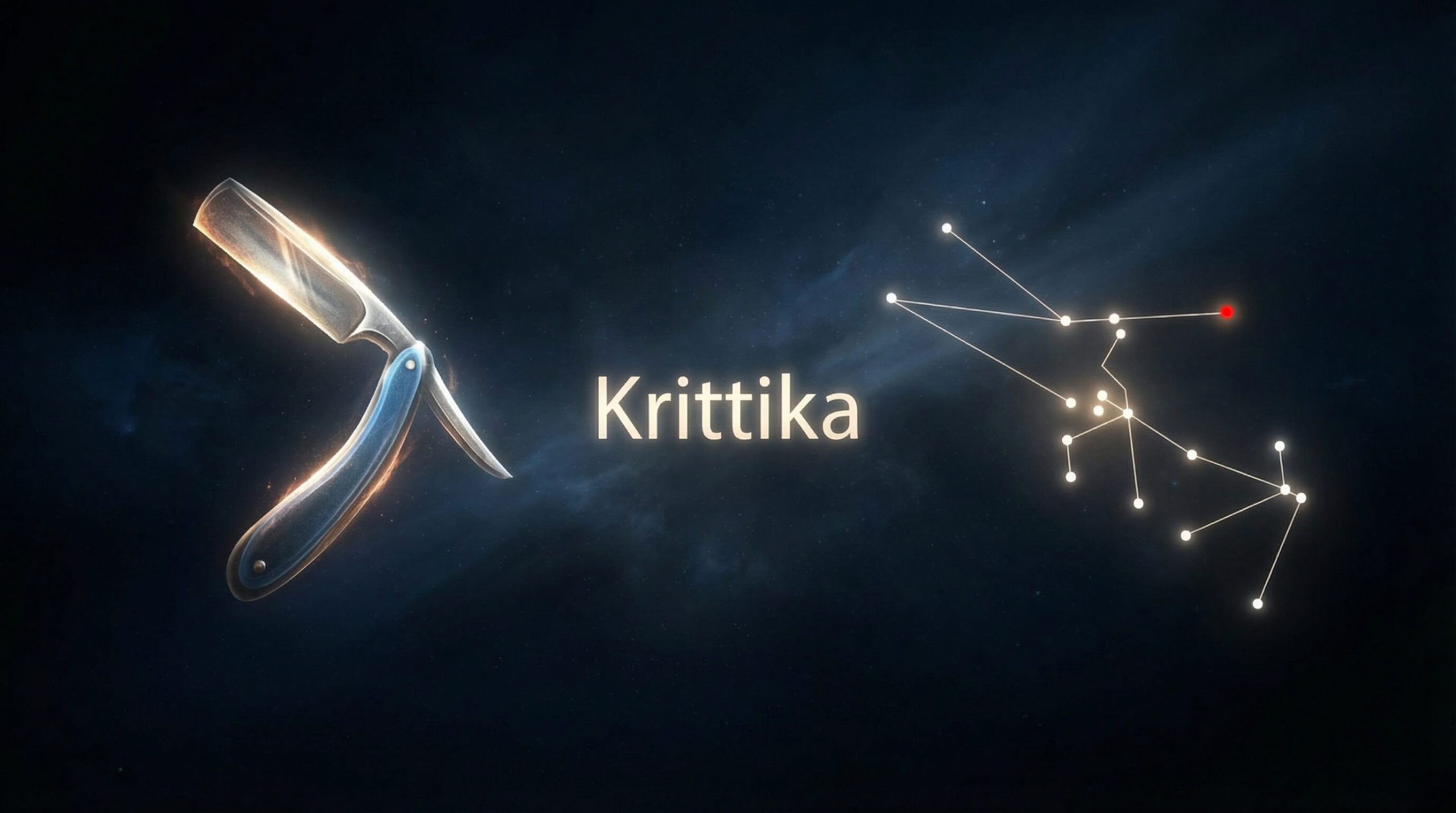
The symbol of this nakshatra is a razor.
Its dominant guna is Rajas (activity) at the primary and secondary levels, while Sattva operates at the tertiary level.
The primary motivation of this nakshatra is Kama — desire.
Astronomically, Krittika corresponds to the star cluster known as the Pleiades. It consists of six visible bright stars, with a seventh that is traditionally considered hidden. These stars are often referred to as the Seven Sisters.
In Vedic tradition, the Seven Sisters are associated with the wives of the seven great seers (Sapta Rishis), who correspond astronomically to the stars of Ursa Major (the Big Dipper). This symbolic linkage highlights their guiding role in the spiritual and evolutionary journey of humanity.
NAKSHATRA & ITS SHAPE
The ruling deity of Krittika is Agni, the fire god. Fire holds a foundational place in Vedic literature and ritual.
The primary source of fire is the Sun.
The purest expression of fire is light — essential for existence.
Fire manifests in many dimensions:
- As lightning, it generates minerals and metals deep within the Earth.
- As digestive fire (Jatharagni), it sustains life within the body.
- As heat, it maintains the temperature necessary for life.
- As latent heat, it supports gestation and hidden forms of manifestation.
Fire possesses both constructive and destructive power. It can create, purify, transform, and also annihilate. Yet fire itself remains imperishable.
The seven flames of fire symbolize seven planes of existence. Through Agni, Krittika becomes a nakshatra of total transformation — the burning away of impurities and the forging of a refined being.
The Hidden Star & Cosmic Axis
It is traditionally believed that the seventh, invisible star of Krittika is mystically connected to Dhruva (the Pole Star). As the Earth rotates around the Pole Star, this connection symbolizes the existence of a central, unseen principle that governs cosmic order.
Thus, Krittika represents not merely fire, but the law of central alignment — the axis around which transformation occurs.
The Birth of Kartikeya
A significant mythological narrative connects Krittika with the birth of Kartikeya.
In ancient times, the demon Taraka grew immensely powerful, disturbing cosmic balance. The gods were unable to defeat him. It was foretold that only a son born of Lord Shiva could destroy Taraka.
The fiery seed of Shiva, however, was too powerful for any ordinary womb. It was cast into fire and protected by water. The Krittikas (the Seven Sisters) were entrusted with nurturing this divine energy.
From this process was born Kartikeya (Skanda), who, on the seventh day after his birth, defeated Taraka and restored cosmic harmony.
This story symbolizes disciplined transformation — raw power purified through fire and directed toward righteous purpose.
GUNAS & MOTIVATIONAL FORCE
The first nine nakshatras are primarily governed by Rajasic energy. However, no manifestation occurs through a single guna alone; the other two operate subtly in the background.
In Krittika:
- Rajas dominates at the primary and secondary levels (action and activity).
- Sattva operates at the tertiary level (higher purpose and purification).
In the birth of Kartikeya, Rajasic energy enabled action and manifestation, while the hidden Sattvic intention was to restore cosmic order.
The Razor Symbolism
The razor represents precision, discrimination, and sharpness.
- In the hands of a surgeon, it removes disease and restores life.
- In careless hands, it becomes destructive.
Krittika holds both possibilities — creative refinement or destructive aggression. Agni reinforces this dual capacity.
The primary motivation of Krittika is Kama (desire). Desire is essential for creation. Without desire, manifestation cannot occur. When guided wisely, Kama produces beauty and excellence. When misdirected, it leads to destruction.
NAKSHATRA TRAITS & PERSONALITY
Strengths
The combination of Krittika–Sun–Mars generates deep-rooted confidence and firmness of character. Individuals born under this nakshatra often display qualities of a spiritual warrior.
Core strengths include:
- Strong search for truth
- Inner transformative fire
- Leadership capacity
- Commitment to social causes
- Methodical and disciplined thinking
- Practical approach to goals
Krittika–Sun–Venus also produces nervous vitality and a strong urge to express creative potential. Passion is directed toward objectives with emotional restraint until results are achieved.
You tend to:
- Channel energy with discipline
- Remain grounded rather than euphoric
- Work patiently without expecting instant success
- Believe in steady effort
There is often a missionary spirit — working not only for personal achievement but for collective upliftment. Once convinced of someone’s sincerity, you can extend yourself fully to support them.
You possess the sharpness of a surgeon’s scalpel — capable of cutting through illusion and confusion. A divine quality of impersonal service may develop naturally.
Drawbacks
The same transformative fire can turn destructive if uncontrolled.
Potential challenges include:
- Stubbornness
- Aggression
- Suspicion
- Jealousy
- Excessive severity
- Lust when desire becomes unregulated
If negative emotions dominate, they may not only harm personal growth but also affect others significantly.
The key lesson of Krittika is conscious regulation of inner fire. When disciplined, it becomes illumination. When uncontrolled, it becomes destruction.
Give a Reply